

Winter tyres in France: the rules for driving to Méribel

Winter tyres in France are compulsory in mountain areas from 1 November to 31 March, unless you carry snow chains or snow socks in the car instead. For the 2026-2027 season the rule covers every road in Savoie, so it applies to the whole drive to Méribel, from the A43 motorway to the car park in Mottaret. If your car runs on ordinary summer tyres, you will need chains or socks in the boot. Below: what the French rules actually say, what a UK-registered car must carry, whether there is a fine, and how to handle the final climb from Moûtiers.
In short
- The rule, known in France as the Loi Montagne, covers all of Savoie and Haute-Savoie, motorways included, from 1 November to 31 March.
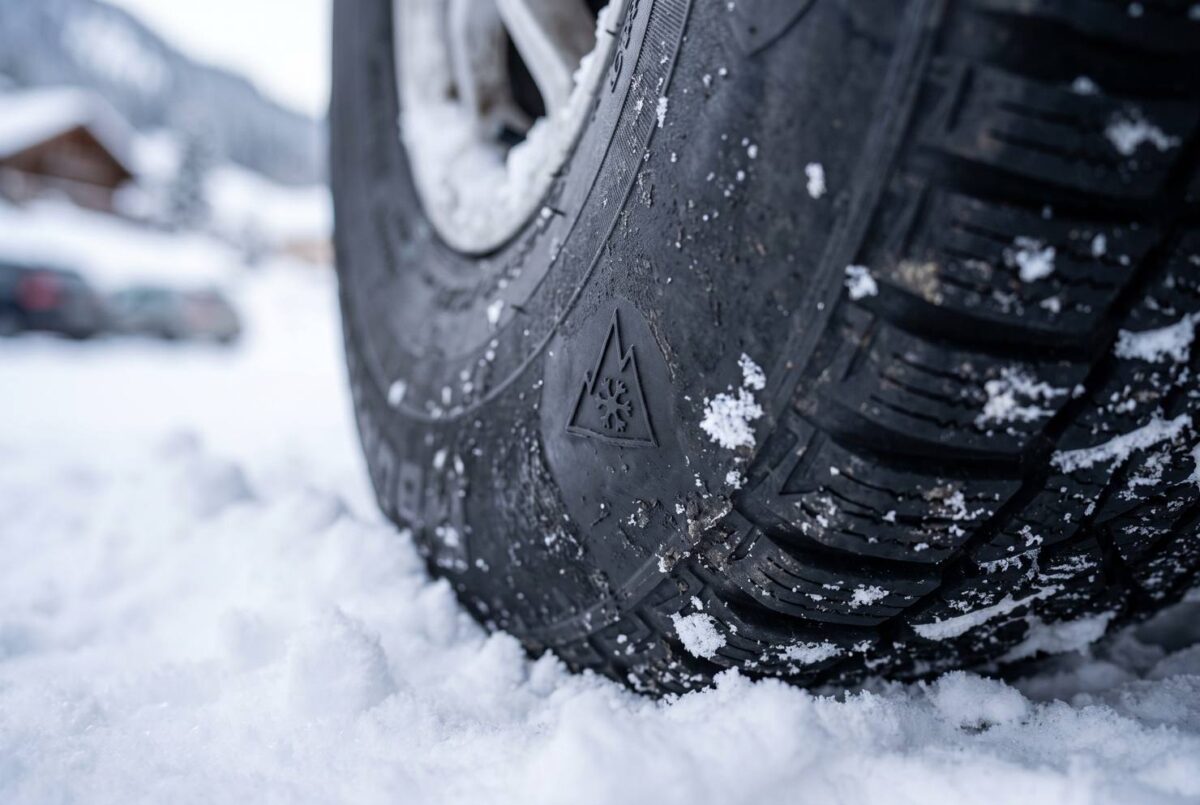
- A tyre only counts as a winter tyre if it shows the three-peak mountain snowflake symbol (3PMSF). Tyres marked only M+S stopped qualifying on their own in November 2024.
- Without 3PMSF tyres on all four wheels, carry chains or snow socks for at least two driven wheels. Fit them on snowy roads and stay under 50 km/h with chains.
- There is no specific fine yet: the French Interior Ministry says it needs a decree, and none had been published by early November 2026. Treat the rule as compulsory all the same.
- A UK car also needs your licence, V5C, insurance certificate, a UK identifier, a hi-vis vest, a warning triangle and adjusted headlamps.
Updated November 2026.
Winter tyres in France: what the law says
The rules come from France’s 2016 mountain law (loi n° 2016-1888, often called Loi Montagne II), put into practice by a decree of 16 October 2020 and now set out in article D314-8 of the French Highway Code. They have applied every winter since 2021-2022. The official summary in English is on service-public.gouv.fr, the French government’s public information site.
Three points cover most of it:
- When: from 1 November to 31 March, whether or not it is snowing.
- Where: in the communes listed by the prefect of each mountain department (Alps, Jura, Massif Central, Pyrenees, Vosges). For winter 2026-2027 that means 34 departments.
- What: for a car or light van, either carry removable anti-skid devices (metal chains or textile snow socks) for at least two driven wheels, or drive on four winter tyres, at least two on each axle.
The rules apply to every vehicle with four or more wheels on French roads, whatever its country of registration: cars, vans, motorhomes, coaches and lorries. Cars fitted with studded tyres are exempt.
What counts as a winter tyre in France?
| Equipment | Enough on its own? | Good to know |
|---|---|---|
| 4 winter tyres with the 3PMSF symbol | Yes | The sidewall shows a three-peak mountain with a snowflake, next to the M+S marking |
| 4 all-season tyres with the 3PMSF symbol | Yes | Without the symbol, an all-season tyre counts as an ordinary tyre |
| Tyres marked M+S only | No | Tolerated until November 2024; now you need chains or socks as well |
| Summer tyres | No | Chains or socks must be in the car |
| Metal snow chains | Yes, carried in the car | Best grip, slower to fit |
| Textile snow socks | Yes, carried in the car | Quick to fit, for occasional use |
| Studded tyres | Exempt | The obligation does not apply |
Source: French road safety agency (in French). Chains or socks must be in the car and ready to use whenever your route passes through a listed area, even on a dry, sunny day.
Where the rules apply on the drive to Méribel
Some departments only listed their mountain communes. Savoie listed everything: the prefect’s order of 27 September 2021 applies the rule “on all communes and roads of the department”, and the Savoie prefecture confirmed it for this winter on 20 October 2026. Chambéry, Albertville, Moûtiers and Les Allues, the commune Méribel belongs to, are all inside the zone, and so is the A43 motorway.
Haute-Savoie did the same in an order of 30 September 2021, so if you drive in from Geneva through Haute-Savoie you are in the zone from the border. If your route from Calais uses the A40 between Bourg-en-Bresse and Geneva, you also cross listed communes in the Ain, such as Nantua and Valserhone. The orders for every department are on the French road safety website.
A sign marks the start of each zone, with a small panel giving the dates (1 November to 31 March), and another marks the end. For a ski trip to Méribel, the simple answer is to leave home equipped: do not count on buying chains at the foot of the mountains on a busy Saturday.
The route to Méribel-Mottaret
According to the Méribel tourist office, you take the A43 motorway to Albertville, then the toll-free N90 to Moûtiers, then the D90 for 18 km up to Méribel. Mottaret sits a few kilometres further up, at the head of the valley, between 1,700 and 1,800 m. That last climb from Moûtiers is where conditions matter most: a wet road in the valley can turn white well before you reach the resort.
Driving a UK-registered car to the Alps: what to carry
Winter equipment is only part of the list. This is what UK government guidance and the French authorities ask for:
| Item | What you need to know |
|---|---|
| Driving licence | A UK photocard licence is valid in France. With an old paper licence, check whether you need an International Driving Permit (GOV.UK). |
| V5C logbook | Carry it for your own car, or a VE103 certificate if the car is hired or leased in the UK. |
| Insurance certificate | No green card is needed in the EU. UK policies include the minimum third-party cover; check your insurer for theft or damage cover abroad (GOV.UK). |
| UK identifier | No sticker is needed if your number plate shows the UK identifier with the Union flag. A plate with GB, a Euro symbol, a national flag of England, Scotland or Wales, or no identifier needs a UK sticker (GOV.UK). |
| Hi-vis vest and warning triangle | Compulsory in France: the vest within reach of the driver, the triangle in the car (service-public.gouv.fr). |
| Headlamps | Adjust the beam or fit headlight converter stickers so you do not dazzle oncoming drivers (GOV.UK). |
| Chains, socks or 3PMSF tyres | Required in the mountain zones from 1 November to 31 March, as above. |
Two points that often confuse British drivers. First, the breathalyser: the French government’s own guidance now lists it as recommended, not compulsory. Second, the Crit’Air pollution sticker: GOV.UK says it is required to drive in central Paris, Lyon and Grenoble on weekdays from 8am to 8pm. If your route goes into one of those cities, order it in advance, only from the official site certificat-air.gouv.fr.
Chains or snow socks: what to buy before you leave
Both are legal. Which one suits you depends on how often you drive in the mountains.
Metal snow chains
Chains give the best grip in deep snow or on ice. They cost more than socks and take longer to fit, especially with cold hands on a narrow verge. Buy them in the UK before you travel, matched to the tyre size printed on your sidewall, and check the clearance between the wheel and the bodywork: on some cars it is very tight. The French road safety agency recommends a practice run before departure, so try them once on your drive at home.
Snow socks
Socks are lighter, cheaper and much quicker to fit, which makes them a sensible choice for a single ski week. They grip less well in heavy snow and wear out fast: the Savoie prefecture puts their life at about 80 km on snowy roads and describes them as an emergency solution. For one return trip to Méribel they meet the legal requirement; if you drive to the Alps every winter, chains or 3PMSF tyres are the better investment.
Winter or all-season tyres
If your car already has all-season tyres, look at the sidewalls before you book the ferry or the tunnel: the mountain and snowflake symbol has to be on all four. Even with 3PMSF tyres, a set of chains in the boot is worth having for heavy snowfall days and for signs that demand chains specifically.
The B26 sign: when you must fit chains
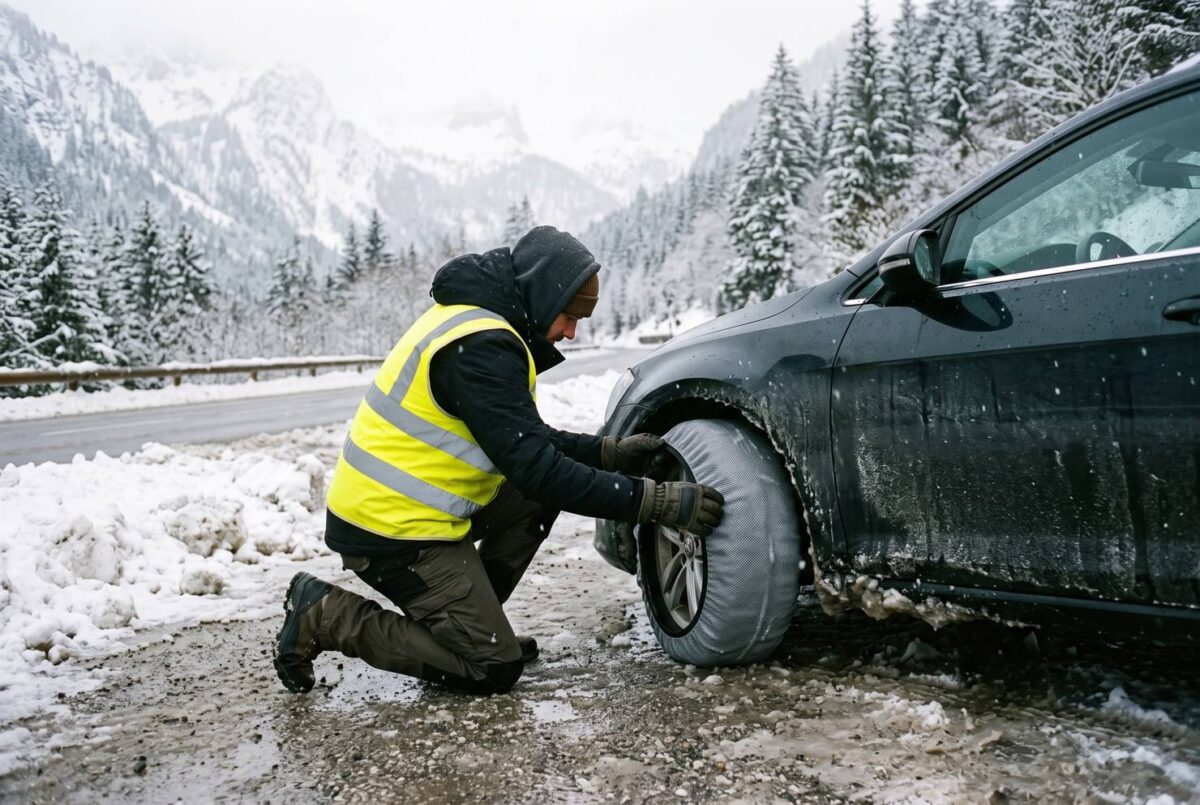
The mountain rule is about carrying equipment. The B26 sign, a round blue sign showing a tyre with chains, goes further: on a snowy road it means chains must actually be fitted on at least two driven wheels, even outside the winter period. Cars on 3PMSF tyres also comply, unless a panel under the sign says “chaînes à neige obligatoires” (snow chains compulsory). The B44 sign marks the end of the requirement.
A few rules and habits, from the French Highway Code and the official road safety leaflet:
- Fit chains as soon as the road is covered in snow, with or without a sign, and before you get stuck halfway up a hill.
- Pick a flat spot with room to work, away from the traffic, and put on your hi-vis vest. Gloves and a head torch make a real difference.
- Keep below 50 km/h with chains and re-tighten them after a few kilometres.
- Take them off once the road is clear: French law only allows chains on snow-covered roads (article R314-3), and dry tarmac damages them.
Is there a fine for driving without winter equipment?
Not yet, as far as the French rules go. In answers to a senator from Haute-Savoie and an MP from Savoie, the Interior Ministry said in February 2026 that the measure has been applied as an education campaign, without penalties, from the start, and that a penalty requires a decree (answer published in the Senate’s official journal on 12 February 2026). No such decree had been published by early November 2026. The €135 fine and vehicle immobilisation quoted on many websites are the penalty under discussion, not one currently applied.
GOV.UK still warns that you could be fined, and a decree can be published at any point in the season, so check the service-public page before you set off. The bigger risk is practical: one car spinning its wheels on the climb blocks everyone behind it, which is exactly what the rule is designed to prevent. The Savoie prefecture’s advice is blunt: if you do not have winter tyres, chains or socks, do not set off. The authorities can also close a road or ban certain vehicles from it to prevent danger.
Arrival day: tips for the climb from Moûtiers
- Check the weather and the traffic the day before. Saturdays in the French school holidays are the busiest days to and from the resorts, and Bison Futé, the French government’s traffic service, publishes its forecasts a few days ahead. An early start or a late-afternoon arrival usually avoids the worst of it.
- Fit chains before you need them, in a flat, safe spot, rather than on a bend once the wheels are already spinning.
- Let snowploughs through and do not overtake them: that is the prefecture’s own advice.
- In falling snow, front fog lights can be used with dipped headlights outside built-up areas and on narrow, winding roads.
- Keep a few things to hand: winter screenwash, water, snacks and warm layers, in case the road slows to a crawl.
If you would rather not drive at all, the train to Moûtiers and a transfer up the valley is the other way in.
Once you reach Le Hameau, the car stays put
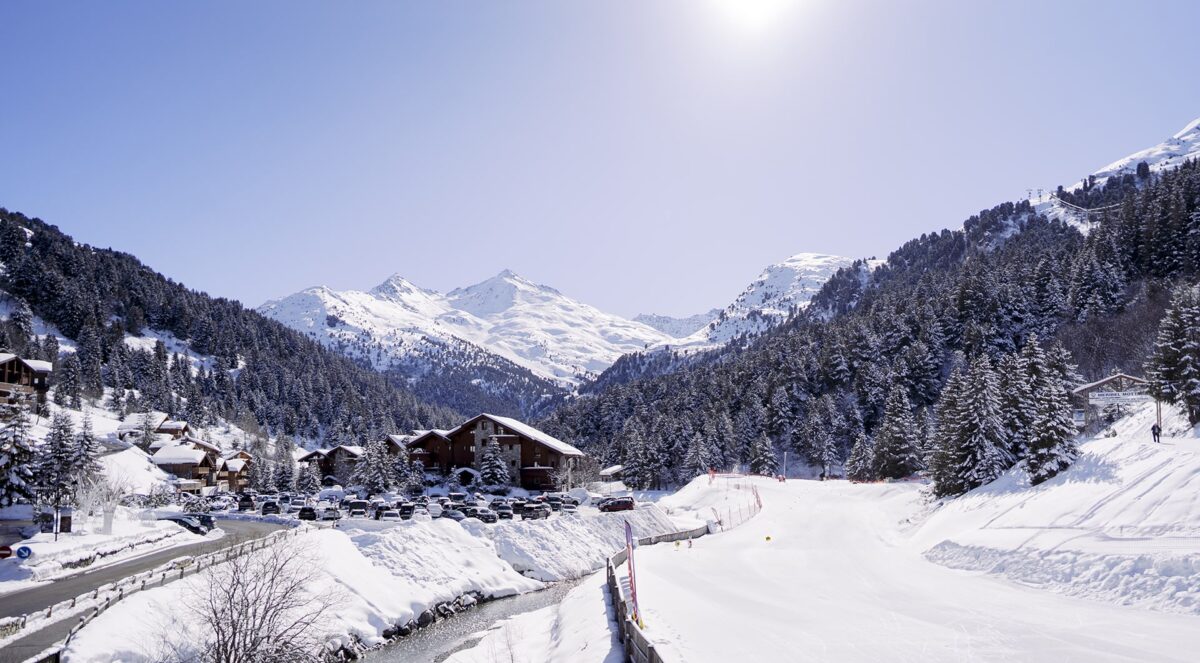
After the climb, there is no reason to touch the car until you leave. In Méribel-Mottaret most journeys are on skis or on foot, and the free Méribus shuttles link the villages of the valley. Our guide to Méribel-Mottaret or Méribel Centre compares the two villages, including for a week without a car.
The Vavril Ski aux Pieds apartment, in the Arpasson residence at Le Hameau, has a private covered parking space that you reach without going outside. A lift serves the apartment, and the ski room, with its bench, lets you get your boots on in the warm before heading straight onto the slopes. Luggage and skis never go through the snow, and on departure day there is no car to dig out and no windscreen to scrape. For evenings out without the car, the Chalets lift, free to use, is less than 25 metres away.
FAQ
Do I need winter tyres to drive in France?
Not necessarily. From 1 November to 31 March, in the mountain zones, you need either four 3PMSF winter tyres or chains or snow socks in the car for two driven wheels. In Savoie, including Méribel, that applies on every road.
Are snow socks legal in France?
Yes. Textile snow socks are accepted in the same way as metal chains, provided you have enough for two driven wheels and they fit your tyres. They suit occasional use and wear out quickly on snowy roads.
Do all-season tyres count as winter tyres in France?
Only if they carry the 3PMSF mountain and snowflake symbol, on all four wheels. All-season tyres marked only M+S mean you still have to carry chains or socks.
Is there a fine for not having winter tyres or chains?
There was no specific fine in force in early November 2026, because the decree creating one had not been published. That could change during the season, and signs requiring chains (B26) must be obeyed in any case.
Does my car need a UK sticker in France?
Only if your number plate does not show the UK identifier with the Union flag. Plates with GB, a Euro symbol, a national flag or no identifier need a UK sticker on the back of the car.
Does the rule apply on French motorways?
In Savoie, yes: the prefect’s order covers all roads in the department, so the A43 is included. Elsewhere it depends on the communes each prefect has listed.
Planning your week in Méribel? Check the apartment’s availability: once you reach Le Hameau, the car is parked under cover and the rest of the week is on skis.