

The World’s Largest Ski Area: Les 3 Vallées by the Numbers Compared to Others

The world’s largest ski area—in terms of kilometers of interconnected slopes accessible directly from the slopes—is Les 3 Vallées: 600 km as reported by the ski area, and 543 km according to the latest published independent measurement, which still ranks it first. Others claim to have more, such as Dolomiti Superski with its 1,200 km, but these are actually several ski areas combined under a single lift ticket. Here are the official figures for each contender, what each title encompasses, and why the rankings don’t all tell the same story.
In a nutshell
- Les 3 Vallées boasts 600 km of slopes, 337 runs, and 169 lifts, at altitudes ranging from 1,100 to 3,230 m, with seven interconnected resorts accessible directly on skis.
- Dolomiti Superski (1,200 km) and Ski amadé (up to 760 km) offer more, but these are networks of ski areas accessible with a single lift ticket, not a single, contiguous ski area.
- Les Portes du Soleil also claims 600 km of “skiing,” including two resorts connected by shuttle; its official title is that of the world’s largest cross-border ski area.
- There are no rules dictating how kilometers should be counted. Measured at the midpoint of each run by cartographer Christoph Schrahe, Les 3 Vallées totaled 493 km in 2013 and 543 km in 2019, topping his global ranking.
- Méribel is the geographic center of the ski area: from Mottaret, Courchevel and Val Thorens are all within a day’s ski trip of each other.
Updated in November 2026.
The World’s Largest Ski Area: Official Figures Side by Side
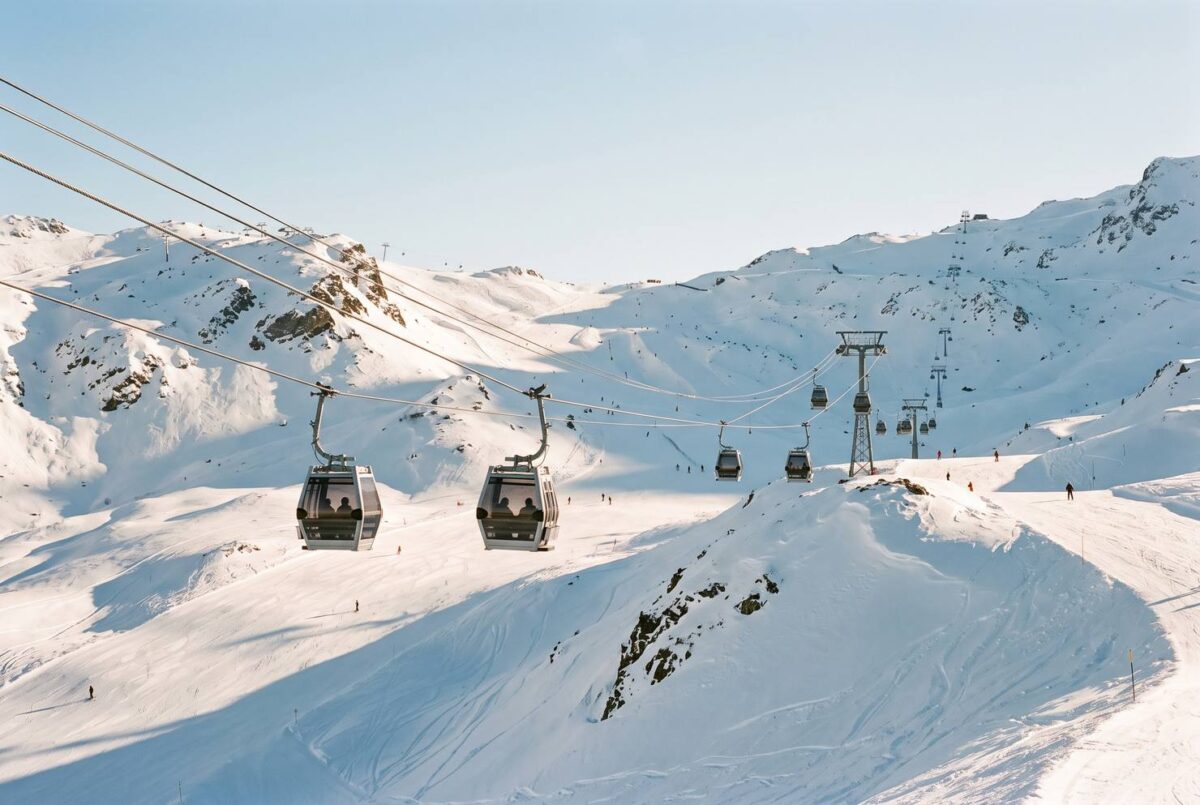
Each resort publishes its own figures and chooses its own wording. In November 2026, we gathered information from their official websites regarding the advertised length in kilometers, how the sections are connected, and the title they claim. The kilometer figures are those provided by each resort, without any adjustments.
| Region | Country | Advertised kilometers | Direct access to the slopes? | What the ski area claims |
|---|---|---|---|---|
| Les 3 Vallées | France | 600 km, 169 lifts | Yes: seven resorts in three valleys | “The world’s largest ski area” |
| Dolomiti Superski | Italy | 1,200 km, 450 lifts | No: 12 ski areas covered by a single lift pass | One of the world’s largest ski destinations |
| Ski amadé | Austria | Up to 760 km, 260 lifts | No: five regions covered by a single lift pass | The largest in Austria, according to its own claims |
| Les Portes du Soleil | France and Switzerland | 600 km of skiing, 12 resorts | For the most part: Abondance and Saint-Jean d’Aulps are connected by shuttle | “The world’s largest cross-border ski area” |
| Paradiski | France | 425 km, 260 runs | Yes: La Plagne and Les Arcs are connected by the Vanoise Express cable car | No global ranking claimed on the page viewed |
| Verbier 4Vallées | Switzerland | 410 km | Yes | “The largest ski area in Switzerland” |
| Milky Way | Italy and France | 400 km | Yes: from Sauze d’Oulx and Sestriere to Claviere and Montgenèvre | One of the largest ski areas in Europe |
| Arlberg Skiing | Austria | 301 km, 85 lifts, plus 200 km of off-piste runs | Yes: St. Anton, Lech, Zürs, and Warth-Schröcken | Austria’s largest ski area, among the five largest in the world |
| Tignes-Val d’Isère (formerly Espace Killy) | France | 300 km | Yes | “One of the largest ski areas in Europe” |
| SkiWelt Wilder Kaiser-Brixental | Austria | 275 km, 81 lifts | Yes | One of the world’s largest ski areas, with 275 km of “decent” runs |
| Saalbach-Hinterglemm-Leogang-Fieberbrunn Ski Circuit | Austria | 270 km of certified slopes, 70 lifts | Yes | One of Austria’s largest ski areas, with length certified by an independent survey |
Viewed this way, the table combines three types of ski areas: single, contiguous ski areas (Les 3 Vallées, Paradiski, Ski Arlberg); groups that are almost entirely interconnected (Les Portes du Soleil); and networks of ski areas sold under a single lift ticket (Dolomiti Superski, Ski amadé). The headings are chosen accordingly: only Les 3 Vallées claims the top global ranking without qualification; the others specify “cross-border,” “in Austria,” “in Switzerland,” or “one of the largest.”
Les 3 Vallées by the Numbers
Here is what the ski area has published on its official website for the 2026–2027 season:
- 600 km of trails connecting 337 ski-in/ski-out runs: 15% green, 41% blue, 33% red, and 11% black.
- 169 ski lifts and 25 accessible peaks, including 10 over 2,500 m.
- Trails ranging in elevation from 1,100 to 3,230 m, with 85% of the ski area above 1,800 m and inter-valley connections all located above 2,000 m.
- More than 2,800 snowmaking guns, covering 55% of the ski area.
- A 105-square-kilometer ski area where, according to the resort, you could ski 100 kilometers a day for a week without ever skiing the same run twice.
The ski area encompasses the Saint-Bon Valley (Courchevel), the Allues Valley (Méribel), and the Belleville Valley (Les Menuires, Saint-Martin-de-Belleville, Val Thorens); Brides-les-Bains and Orelle round out the seven resorts. According to the tourist office, Méribel is the geographic center of the ski area. Connections between the valleys are open from December 5, 2026, to April 18, 2027, according to the official calendar; Val Thorens and Orelle open as early as November 21.
To ski throughout the entire resort, you’ll need the 3 Vallées lift ticket: €421 for six days at the adult rate starting December 19, 2026. The Vallée de Méribel ski pass, which is limited to the 150 km of trails between Les Allues and Méribel-Mottaret according to meribel.net, is less expensive. All options and time periods are listed in our article on the 3 Vallées ski pass and its prices.
Why Rankings Don’t Tell the Whole Story
A related domain or a shared package
The first criterion is the simplest: Can you ski from one end to the other, linking runs and lifts, without a bus or car? Dolomiti Superski itself highlights its “12 ski resorts” accessible with a single lift ticket; its most famous circuit, the Sellaronda, circles the Sella massif, passing through four mountain passes. Ski amadé brings together five regions. The Portes du Soleil claim to be connected, but their website specifies thatAbundance is connected to the estate by a “regular shuttle service” and Saint-Jean d’Aulps “by bus.” The 1,200 km of the Dolomites therefore represent what a ski pass covers; the 600 km of the 3 Vallées represent a single, contiguous ski area. Both figures are accurate, but they don’t answer the same question.
How are the kilometers of ski runs measured
There are no mandatory rules. In 2013, the International Federation of Ski Lift Operators (FIANET) adopted a method: measuring each run along its centerline, at equal distances from both edges, and adding only the actual length of each branch. These recommendations remain optional, as the Saalbach ski area points out. When asked about the discrepancies identified by independent measurements, some resorts explained that they had followed a skier’s track through turns rather than the center of the run, or had counted a wide run multiple times. Other choices also inflate the total:
- count each run separately on a section it shares with others;
- include marked but ungroomed trails, or even off-piste skiing. Ski Arlberg clearly distinguishes its 301 km of trails from its more than 200 km of off-piste runs; the Portes du Soleil refers to “km of skiing”;
- maintaining a round number for years, even as trails are added or removed.
Two sections of the table highlight a specific measurement: SkiWelt mentions 275 km of “genuine” trails, and the Saalbach Skicircus lists 270 km certified by the “Certified Run Length” label, awarded following a measurement by Christoph Schrahe according to his method.
Kilometers or hectares
In North America, people don’t measure in kilometers but in skiable area. Whistler Blackcomb, in Canada, claims to be the largest ski resort in North America, covering 8,171 acres (approximately 3,300 hectares), including trails, valleys, and glaciers. Park City It claims to be the largest in the United States, covering 7,300 acres (approximately 2,950 hectares). Les 3 Vallées claims a ski area of 105 km², or 10,500 hectares. These areas are not defined in the same way, so it is not possible to establish a precise ranking; moreover, none of these North American ski resorts claims to be the world’s largest.
What the independent measurement shows:
German cartographer Christoph Schrahe measures ski areas on digital maps along the centerline of each run, counting only the sections that are connected without interruption. In 2013, he measured 493 km for Les 3 Vallées—22% less than the advertised 600 km—and 425 km for the Portes du Soleil, which had advertised 650 km at the time, according to an AFP report carried by La Libre Belgique. On average, the European resorts studied inflated their totals by 34 percent.
Its list of the world’s largest ski areas, published through 2019, still ranked Les 3 Vallées at the top, with 543 km measured, according to the 2019 report published by In The Snow. In terms of measured kilometers, Paradiski came next with 402 km, and the largest interconnected ski area in the Dolomites, around the Sellaronda, totaled 353 km. The difference between 2013 and 2019 is due to newly added runs and remeasurements.
Two points to clarify, for the sake of completeness. These figures are outdated: the list has not been updated since 2019. And Les 3 Vallées is not neutral on the issue: in December 2025, they announced their support for reviving this ranking, according to Christoph Schrahe’s office; the crowdfunding campaign ended in February 2026 without reaching its goal.
Our analysis: Based on the criterion “ski-in/ski-out area, in kilometers of trails,” Les 3 Vallées remains in first place, even after the kilometers were recounted. Based on the criterion “kilometers accessible with a single lift ticket,” Dolomiti Superski takes the lead. When it comes to skiable area, comparisons between Europe and North America remain rough estimates.
How the size of the ski
area
makes a difference for a week of skiing
A large ski area is only useful if you take advantage of it. Here are three tips for making the most of it:
- Switch valleys every other day. On sunny days, head out early to Courchevel or Val Thorens, and save the cloudy days for the valley where you’re staying.
- Leave some leeway for the return trip. All the connecting runs are above 2,000 m: on a windy or foggy day, some may close. Figure out the night before which lift you’ll need to take to get back.
- Choose your ski pass based on your group. Beginners who stick to the easy runs in Méribel don’t need the 600 km; experienced skiers will make full use of it starting on the second day.
From Méribel-Mottaret, you can reach Courchevel via the Pas du Lac, and Val Thorens and Les Menuires via Côte Brune. The routes, return runs, and times to keep in mind are detailed in our article on the Map of the Méribel Ski Trails.
The 600 km from the apartment door

Our apartment, Vavril Ski aux Pieds, is located in the L’Arpasson residence, in the Hameau de Méribel-Mottaret, at 1,750 m: you can put on your skis as soon as you step outside and head straight to the slopes, right in the heart of the 3 Vallées. It’s a chalet-style duplex for 6 to 7 people, with 3 bedrooms, 2 bathrooms, a ski storage room equipped with a bench, a private covered parking space accessible without going outside, and a south-facing balcony overlooking the slopes. After a day in Courchevel or Val Thorens, you can ski right back to the residence—no shuttle or car needed. Photos and description on the page at the apartment.
Frequently Asked Questions
What is the largest ski area in the world?
When it comes to a ski-in/ski-out interconnected
ski
area, Les 3 Vallées—with 600 km reported and 543 km according to the latest independent measurement (2019)—still ranks first. If we’re talking about the number of kilometers accessible with a single lift ticket, it’s Dolomiti Superski, with 1,200 km spread across 12 ski areas that aren’t all interconnected.
Are the 3 Vallées really 600 km long?
600 km is the official figure. Measured at the midpoint of each run by Christoph Schrahe, they totaled 493 km in 2013 and 543 km in 2019. The discrepancy stems from the calculation method, and the ski area remains the largest in both cases.
What is the largest ski area in France?
Les 3 Vallées. Les Portes du Soleil also claims 600 km, but of “skiable terrain,” across a Franco-Swiss ski area where two resorts are connected by shuttle. Paradiski follows with 425 km claimed, and 402 km measured in 2019.
Is Dolomiti Superski larger than Les 3 Vallées?
In terms of the ski pass, yes: 1,200 km and 450 lifts across 12 ski areas. In terms of connected ski areas, no: in 2019, the largest connected ski area in the Dolomites, around the Sellaronda, was measured at 353 km, compared to 543 km for Les 3 Vallées.
Where should you stay to enjoy the entire 3 Vallées ski area?
Right in the center—that is, in the Méribel Valley—from where you can ski to both Courchevel and Val Thorens in a single day. In Mottaret, at the top of the valley, you’ll find the Pas du Lac lifts heading toward Courchevel, as well as access to Côte Brune, which leads to Val Thorens and Les Menuires.
Want to ski all 600 km starting from the center of the ski area? Check the calendar for available dates for the 2026–2027 season: your request will go directly to the Vavril team.